 Fiscaloom
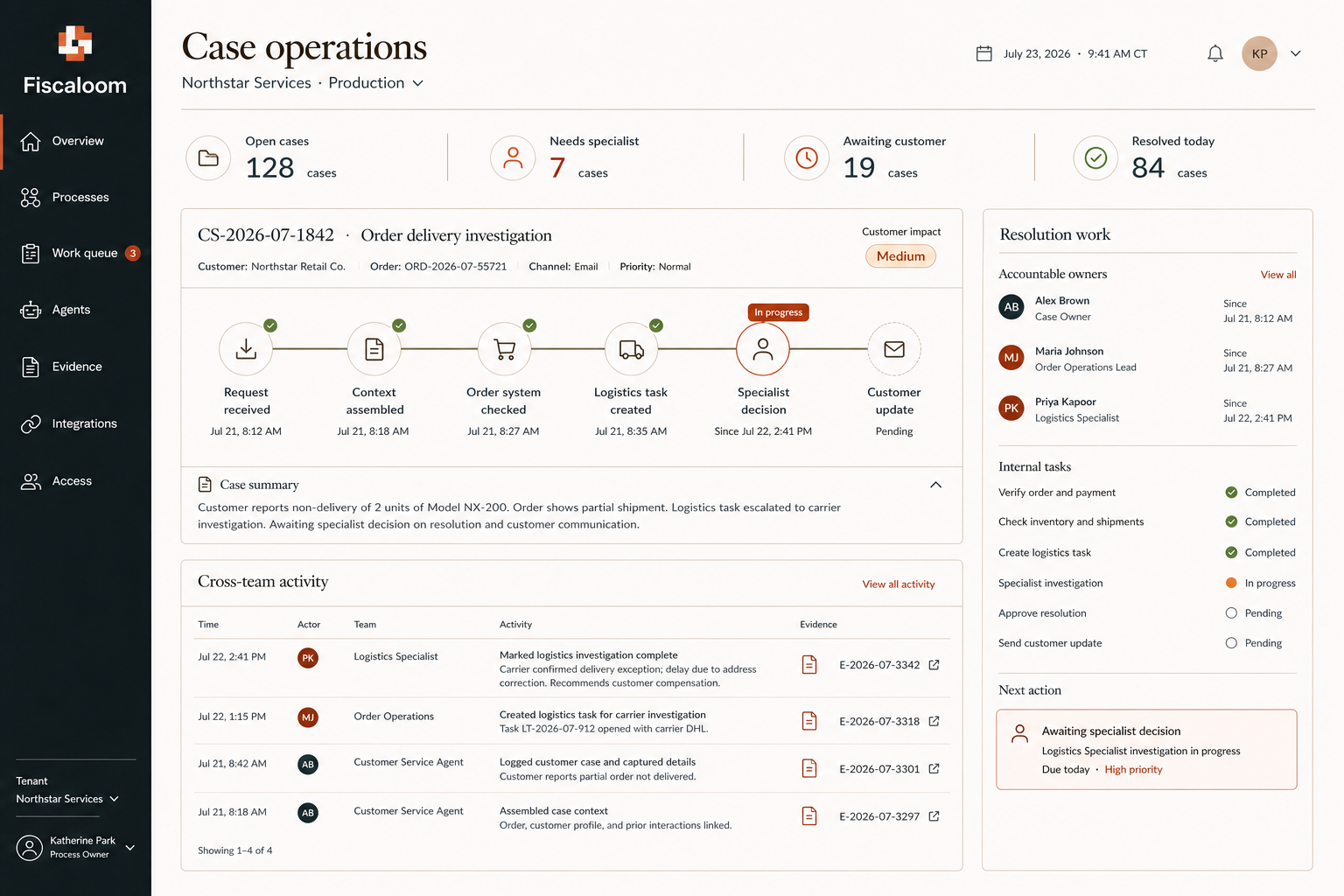
Escalation is not a failure of service automation. It is a controlled route for cases that require authority, empathy, specialist judgment, or work in another business system.
Define escalation triggers by consequence
Consider financial impact, vulnerability, regulatory relevance, repeated contact, unresolved operational dependency, sentiment, and uncertainty. Do not rely on a confidence score alone for high-impact cases.
Give the specialist a complete handoff
Provide the customer request, interaction summary, verified facts, actions already taken, policy context, unresolved question, and recommended next step. Make it clear which content was generated and which facts came from authoritative systems.
Return the outcome to the case record
After resolution, update the owning case, record the decision and action, and communicate the outcome through the approved channel. Use repeated escalation patterns to improve knowledge and routing.
Create an escalation matrix for sensitive outcomes
Define triggers for financial commitment, vulnerable customers, legal or regulatory relevance, safety concerns, repeated unresolved contact, identity uncertainty, policy exception, and specialist product knowledge. Combine deterministic conditions with model-supported signals where appropriate, but do not rely on sentiment or confidence alone for material decisions.
For each trigger, name the receiving team, priority, required context, allowed interim response, service expectation, and channel. Test simultaneous triggers so the workflow selects the safest route rather than whichever rule runs first.
Use resolved cases to improve the service path
Record why the case escalated, whether the route was correct, what information was missing, the specialist decision, and whether the customer needed further contact. Review patterns without copying sensitive case content into broad analytics or model context.
Update knowledge, intake questions, routing rules, and specialist guidance through controlled changes. Some escalation categories should remain human-led even when volume is high. Improvement means clearer preparation and faster ownership, not necessarily removing specialist judgment.
Further reading
These primary references informed the operating principles in this guide.