 Fiscaloom
The trigger, boundary, outcome, owners, variations, and exceptions.
Implementation
Turn one real process into an operating system.
Fiscaloom engagements begin with diagnosis, progress through an agreed statement of work, and end with a workflow the customer can own and operate.
Process Studio
Engagement path
A sales-led path from diagnosis to customer access.
- SignalDiagnose the process
- ContextDefine scope and agree the SOW
- DecisionProvision a dedicated tenant and connect systems
- ActionConfigure and validate the agreed workflow
- ReviewCustomer administrator invites approved employees
What to bring
Make the conversation specific from the start.
A useful working session focuses on one process and includes the people who understand how it operates today.
- A process map or practical walkthrough
- Teams and decision owners
- Systems, inputs, and outputs
- Approval rules and access boundaries
- Common exceptions and handoffs
- The operational outcome to improve
Implementation artifacts
Make the operating design explicit.
Every deliverable is adapted to the agreed SOW, but the implementation must leave the customer with a clear process, control model, and ownership structure.
The systems, access methods, actions, records, and environment constraints.
The rules, permissions, approvals, evidence, and escalation responsibilities.
The conditions that make the workflow ready for controlled operation.
The ownership, support, review, and change practices required after launch.
Process Studio
Configuration is part of delivery, not public self-service.
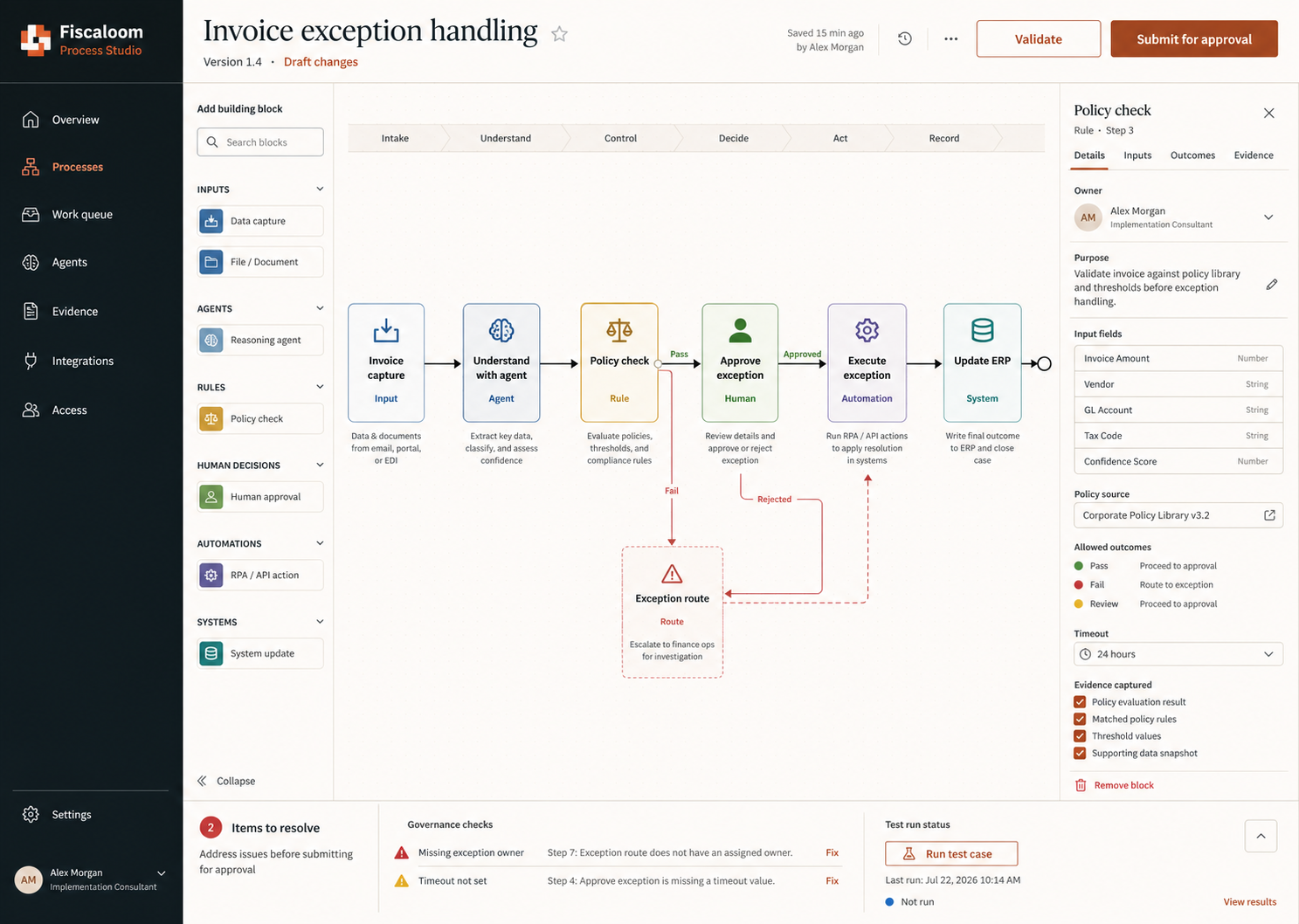
Fiscaloom’s implementation team uses Process Studio to turn the agreed process into a controlled release. Customer stakeholders validate the operating design, permissions, scenarios, and acceptance evidence before launch.
Define triggers, context, decisions, actions, exceptions, and owning records.
Test standard work, missing information, conflicting evidence, unavailable systems, and out-of-scope requests.
Capture acceptance evidence and launch only after responsibilities and controls are agreed.
Responsibility model
Implementation needs business and technical ownership.
Fiscaloom implementation team
Configures the agreed workflow and works with the customer through validation.
Executive sponsor
Resolves business scope, priority, and ownership decisions.
Process owner
Explains the current flow and validates the future operating rules.
IT and security stakeholders
Review systems, access, data, environments, and technical requirements.
Customer administrator
Controls employee invitations to the provisioned tenant.
Governance by design
Agree the operating boundary before launch.
Implementation makes approval boundaries, access responsibilities, exception ownership, change decisions, and operational review explicit. Technical behavior is confirmed during diligence and scope definition.
Working session
Start with the process you want to operate better.
Share the workflow and its current constraints. The next step is a focused working session—not an account or automatic proposal.