 Fiscaloom
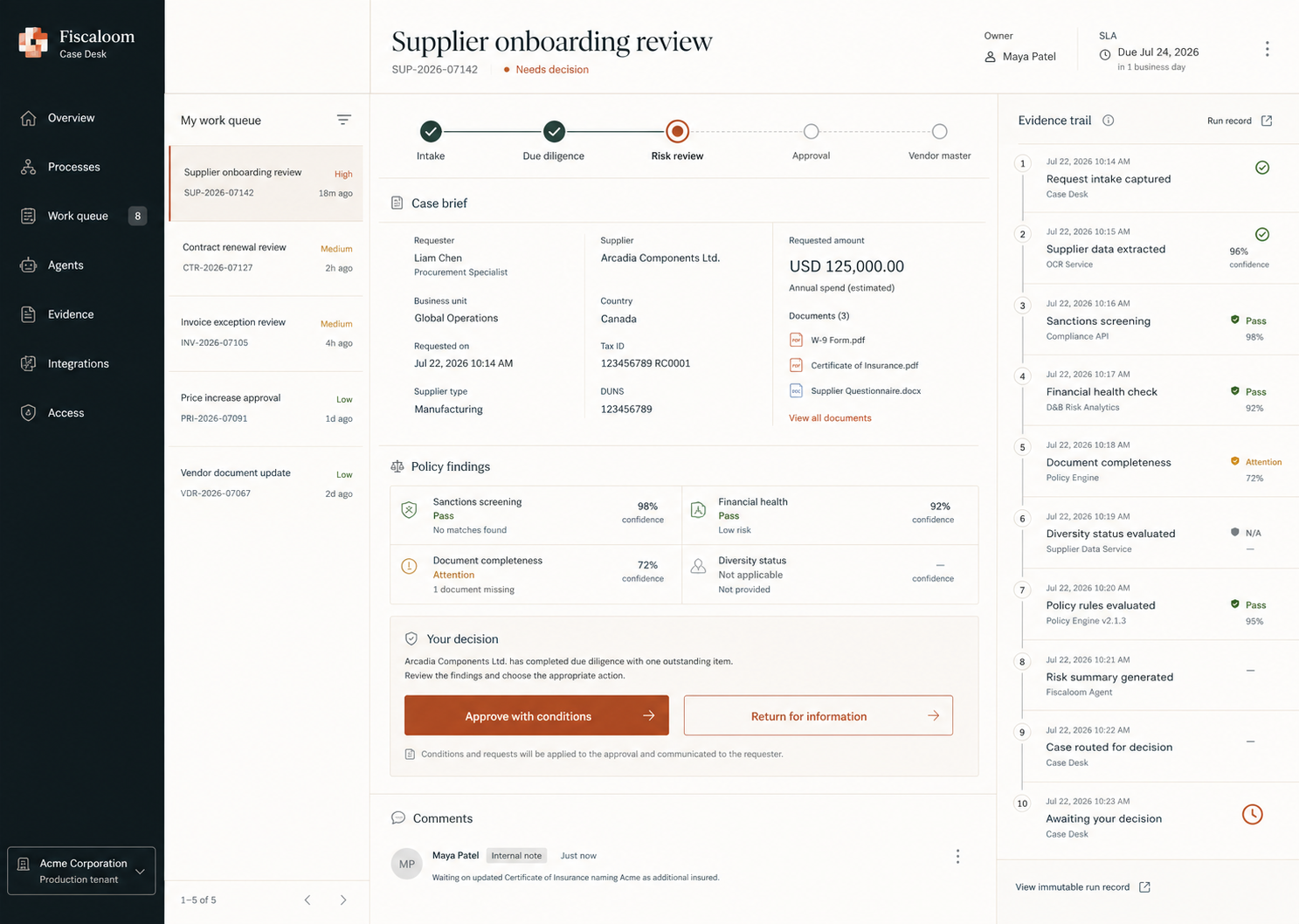
Procurement delays often begin before procurement receives a workable request. A controlled intake workflow can gather the right context, apply routing rules, and return incomplete or out-of-policy requests without hiding decision ownership.
Define the minimum workable request
Specify the business need, category, estimated value, timing, requester, cost owner, existing supplier context, required attachments, and policy-sensitive conditions. Ask only for information used in the process.
Route by policy and responsibility
Use deterministic rules for clear thresholds and mandatory reviews. Use reasoning to classify free-text needs or identify missing context, then let accountable roles decide exceptions.
Make status a product of the workflow
Record which team owns the request, what information is missing, which approval is pending, and the next action. Requesters should not need parallel email threads to understand progress.
Build an intake schema around procurement decisions
Ask for information that determines ownership and route: business need, category, value, timing, cost owner, location, incumbent supplier, data or security considerations, required attachments, and whether work has already started. Use conditional questions so low-complexity requests are not burdened with fields relevant only to sensitive sourcing.
Validate known values against authoritative sources where possible, such as cost centers, approved suppliers, and requester identity. When free text is used for classification, show the proposed category and allow correction. A wrong category can send the request to the wrong policy path.
Make policy routing understandable to requesters
Tell the requester what information is missing, why a review is required, who currently owns the request, and what happens next. Use policy language that a business user can act on. A status such as “pending” is insufficient if it does not identify the pending decision or responsible team.
Capture common returns, clarification loops, and abandoned requests. They may reveal that the form asks questions too early, guidance is unclear, or ownership is fragmented. Improve the intake without weakening mandatory reviews or concealing out-of-policy demand.
Further reading
These primary references informed the operating principles in this guide.