 Fiscaloom
User acceptance testing should prove that the workflow can be operated safely—not simply that a model produces a reasonable answer. Business owners need to see how the complete process behaves under representative conditions.
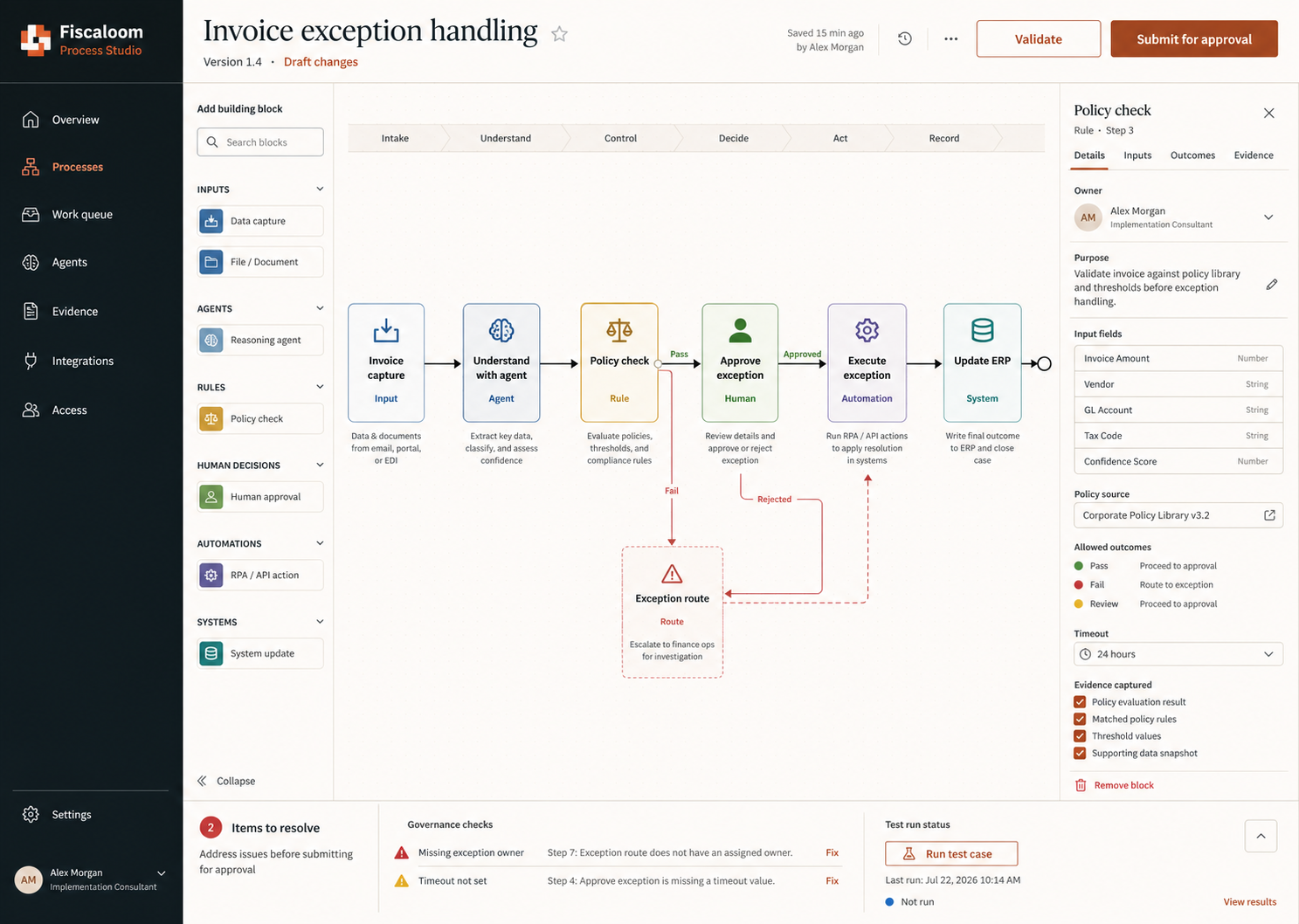
Build a scenario library from real process variation
Include standard cases, incomplete inputs, conflicting data, policy thresholds, sensitive cases, unavailable systems, duplicate requests, and corrections. Remove unnecessary personal or confidential data from test material.
Define expected behavior and evidence
Each scenario should state the expected route, required human decision, permitted action, final record, and evidence. Reviewers need a clear basis for pass, fail, and accepted limitation.
Connect sign-off to residual risk
Document unresolved defects, workarounds, excluded cases, monitoring needs, and rollback conditions. Acceptance is a business decision about fitness for the approved scope, not a declaration that the workflow is universally correct.
Assign business roles to the test process
The process owner defines fitness for the approved outcome; operators execute realistic cases; control owners inspect approvals and evidence; system owners confirm final records; delivery teams diagnose defects. Name who can accept a limitation and who cannot. Technical completion alone should not authorize release.
Use sanitized representative material and preserve the relationship between inputs, expected route, decision, action, and final record. Random examples can test general behavior, but they rarely cover the policies, thresholds, and exceptions that determine whether the workflow is operable.
Triage defects by operating consequence
Classify failures by their effect: unauthorized action, incorrect record, missing approval, unhandled exception, unavailable service, misleading evidence, poor usability, or cosmetic issue. Severity should reflect business consequence and detectability, not only whether the test script completed.
For each unresolved item, document workaround, exposure, owner, target date, and release decision. Retest corrected cases and relevant neighboring scenarios. A fix to one classification or rule can change other routes, so keep a regression set that reflects the process rather than isolated screens.
Further reading
These primary references informed the operating principles in this guide.